
Practice · August 30, 2026 · 4 min read
How to use Pause Protocol with your partner to build trust during conflict
A practical, two-person way to use the pause timer, sealed notes and pattern history so conflict becomes information instead of damage.
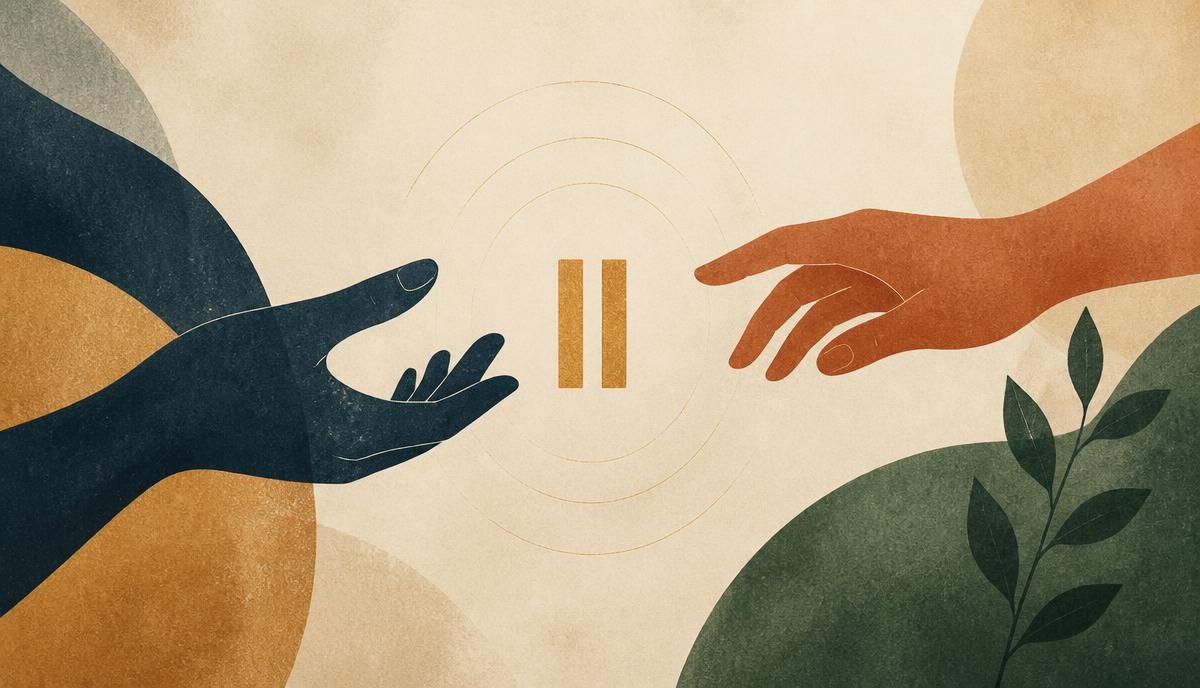
Most couples do not have a communication problem. They have a timing problem. One of you needs to talk immediately or the fear becomes unbearable; the other needs quiet or the words stop making sense. Both of those needs are real, and in the middle of a fight they collide.
Pause Protocol is built for exactly that collision. Used alone, it helps you hold a pause instead of sending the message you would regret. Used with your partner, it becomes a shared agreement — a small, repeatable ritual that keeps conflict from turning into damage.
Start with an agreement, not an app
Before either of you opens the app, agree on three sentences. Write them down somewhere you can both see.
- Either of us can call a pause. No permission needed, no negotiation in the moment.
- A pause has a length. Twenty minutes is the default. It is not silence forever.
- We always come back. The pause ends with a check-in, even if the check-in is "I need until tomorrow morning."
That third sentence is the one that builds trust. For an anxiously attached partner, a pause without a return date reads as abandonment. A pause with a promised return reads as care.
Pair your accounts
In the app, open Partner and share your invite code. Once your partner accepts, you can send each other sealed notes and see that a pause is happening without having to explain it.
Pairing does not expose your journal, your urge log or your patterns. Those stay private. What your partner sees is what you deliberately send.
The four-step conflict protocol
1. Call the pause out loud, then start the timer
"I want to keep talking, and I can feel myself getting flooded. Twenty minutes?" Then open the guided pause and start it. The timer does two useful things: it gives your body a container, and it tells your partner this is a practice, not a punishment.
2. Regulate first, think second
While the timer runs, use box breathing or the grounding walkthrough. Do not use the pause to build a legal case. If the argument keeps replaying, write it into the journal or the urge log — that is what they are for. The goal is to bring a calmer nervous system back to the table, not a better argument.
3. Send one sealed note instead of five texts
A sealed note is a single message your partner reads when they are ready. Use it for reassurance, not for the rebuttal:
- "Still here. Still choosing you. Back at 8:15."
- "I got scared, not angry. I'll explain properly when we sit down."
One note, sent once, does more for trust than nine escalating texts. If you tend to send the nine, the urge log is where the other eight go.
4. Come back and name the pattern, not the person
When you reconnect, each of you answers two questions:
- What did I feel just before I reacted?
- What did I actually need in that moment?
That is it. No verdicts. Over a few weeks the pattern history will show you both something more useful than any single fight: the hours, triggers and feelings that keep showing up. "This happens on Sunday nights when plans are vague" is a problem two people can solve. "You always do this" is not.
What to review together, and how often
Once a week, take fifteen minutes and look at the long view together.
- Progress — how often a pause was held, and how many minutes you spent regulating instead of reacting.
- Patterns — the recurring trigger and the recurring hour.
- Victories — the moments one of you did the harder, quieter thing.
Read the victories out loud. Anxious attachment is very good at storing evidence of danger and very bad at storing evidence of repair. The victories log exists to correct that imbalance on purpose.
What not to do with it
- Do not use pauses as punishment. A pause with no return time is a stonewall wearing a nicer name.
- Do not read each other's private entries. The journal only stays honest if it stays yours.
- Do not treat the pattern history as a scoreboard. It is a map of the loop you are both standing in, not a record of who is worse.
- Do not skip the check-in because things feel fine. The check-in is what teaches your nervous system that returning is reliable.
Give it four weeks
The first pause will feel awkward and slightly performative. The fourth will feel like relief. Somewhere around week three, most couples notice the same thing: the fights are not shorter because they are suppressing them — they are shorter because the flood arrives and passes without anyone leaving.
If you want the two-person version of this in one place, the free toolkit has the printable worksheet and journal prompts, and the pause and check-in practice explains why a short, timed pause works when white-knuckling does not.
Keep reading
More from the anxious-attachment journey.
Practice · August 31, 2026 · 2 min read
Coping strategies for anxious attachment, sorted by how bad it feels
A kit for the moment the urge is already at eight out of ten — what to do at nine, at six, and at three, and which habits quietly make the spikes worse.
Guide · August 31, 2026 · 5 min read
How to stop texting someone: texting anxiety and the pursue-withdraw loop
You do not need more willpower to stop texting someone — you need somewhere for the next twenty minutes to go. Here is how texting anxiety feeds the pursue-withdraw loop, and the five-step method that breaks it.
Practice · August 31, 2026 · 4 min read
Anxious attachment in real life: six scenarios and what to do in each
The read receipt, the weekend away, the vague "we need to talk", the party you were not invited to. Six situations that reliably set off anxious attachment, with a concrete script for each.
Practice · August 17, 2026 · 2 min read
Waiting for a text back: what to do with twenty minutes that feel like hours
The wait is where anxious attachment does most of its damage. A concrete plan for the specific stretch between sending and hearing back.
Free worksheet
Or browse the free anxious attachment toolkit — worksheets, journal prompts and a printable guide.